







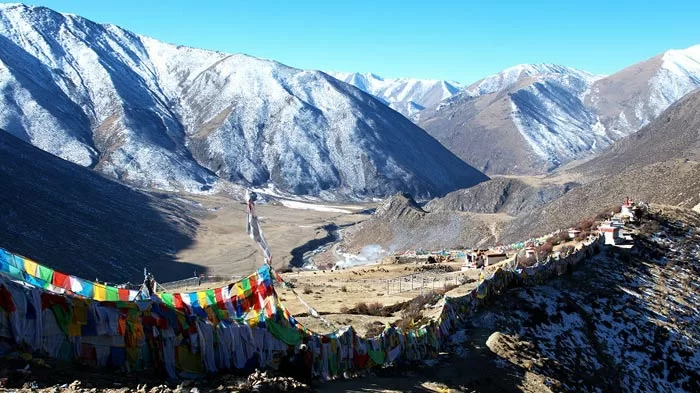








Tibetan funeral traditions offer a profound window into how Tibetan Buddhism understands life, death, and the natural world. At their heart is the conviction that the body is a temporary vessel: once the soul departs, the physical form is returned to nature in a final act of generosity.
This article explores sky burials — the most distinctive Tibetan funeral rite — alongside the other customs that make up this rich tradition.
{{snapshot}}
At a glance
What it covers
Tibetan Buddhist funeral customs, centred on sky burial (jhator), and how they reflect beliefs about impermanence and rebirth.
Who it's for
Anyone exploring global funeral traditions, grief and loss in different cultures, or the spiritual dimensions of death.
Key takeaway
Tibetan funerals are not about endings — they are about continuation, compassion, and returning the self to the cycle of life.
{{/snapshot}}
What is a sky burial?
Sky burials, or jhator in Tibetan (meaning "alms to the birds"), are a centuries-old funeral practice rooted in Tibetan Buddhism. The deceased's body is taken to a designated mountaintop site — known as a charnel ground — where it is offered to vultures and other scavenging birds.
While this may seem unusual to outsiders, Tibetans regard it as an act of compassion and ecological responsibility: feeding hungry creatures and returning the physical form to the natural world. The practice is found across Tibet and in neighbouring regions including Qinghai, Sichuan, and parts of Inner Mongolia.
The sky burial process
After death, the body is wrapped in cloth and left for several days while monks perform religious rites to guide the soul on its journey. The body is then carried to the charnel ground, where a specialist practitioner called a rogyapa (body breaker) prepares the remains using ritual tools, making it easier for the vultures to consume.
The vultures — considered sacred in Tibetan culture — descend and devour the body. This is understood as part of the natural order: the dissolution of the ego and the return of matter to the elements. Once the birds have finished, any remaining bones are crushed and mixed with barley flour so that nothing is left.
The spiritual meaning
In Tibetan Buddhism, death is a transition rather than an end. The body, seen as a temporary home for the spirit, has no lasting significance once the soul departs. Offering it to the birds is the ultimate act of generosity — the last gift of the physical self to other living creatures.
This practice is closely linked to the Buddhist understanding of impermanence (anicca): all things, including the body, are transient. Releasing attachment to the physical form is an important step in freeing the soul for reincarnation.
Other Tibetan funeral customs
| Custom | Who it is for | Description |
|---|---|---|
| Stupa burial | High Lamas (e.g. the Dalai Lama) | The embalmed body is enshrined in a stupa for veneration. |
| Sky burial (jhator) | Most lay people | Body offered to vultures at a mountaintop charnel ground. |
| Fire burial (cremation) | Senior monks and aristocrats | Ashes may be scattered or stored in a sacred tower. |
| Water burial | Commoners where sky burial is impractical | Body placed in a river or lake. |
| Earth burial | Those who died from infectious disease or violence | Rarely practised; the only form involving burial in the ground. |
| Cliff or tree burial | Children (tree); southern Tibet (cliff) | Body placed in a wooden case and set on a cliffside or in a tree. |
The decline and preservation of sky burials
Sky burials have become less common in recent decades. Modernisation, Han Chinese cultural influence, and government restrictions have all played a role. As more Tibetans move to urban areas, cremation and other burial practices are becoming more prevalent.
However, efforts to preserve the tradition continue. Some charnel grounds are now protected sites, and rogyapas continue to train new practitioners. For many Tibetans, sky burial remains an essential expression of spiritual belief and cultural identity.
Frequently asked questions
Are sky burials still practised today?
Yes, though less widely than in the past. They are still performed in rural Tibet and some neighbouring regions, particularly for lay people whose families follow traditional Buddhist customs.
Are sky burials open to visitors?
Access is generally restricted. Sky burials are considered sacred and private rites. Foreign visitors are typically not permitted to observe them, both out of respect for the deceased and for the families involved.
How does this compare to other cultural funeral traditions?
Every culture brings its own understanding of death and the body. If you are exploring global funeral customs, our guidance section includes articles on other traditions, including funeral traditions in Africa and Mexico's Día de los Muertos.
Sky burials are a powerful reminder that there is no single way to honour the dead. Different cultures have developed their own profound, meaningful ways to mark the passing of a life — and to celebrate the continuation of the soul. To explore more funeral traditions from around the world, visit our guidance page.