When someone dies in Spain: what to do, in order
A death in Spain follows Spanish rules first and British ones second. Here are the calls to make, in order, what the Spanish side does, and the three choices a family has once the authorities release your loved one.


Need to talk to someone?
We answer at any hour, and a call costs nothing. Tell us where your loved one is and we will tell you what happens next.
020 4559 2705At a glance
- What it is
- The steps after a British person dies in Spain, from the first phone call to a funeral in Spain or in the UK.
- Who does it
- A Spanish funeral director registers the death. The travel insurer, if there is one, appoints the funeral directors. The consulate advises but does not pay or arrange.
- How long it takes
- Spanish registration and release come first. If a judge orders a post-mortem, that sets the pace. Once your loved one is released, a repatriation usually takes 2 to 7 days.
Most families hear the news from a hotel, a hospital or the police, in a language they may not speak, with someone already asking which funeral director to call. The order below is the one that keeps every choice open, and it starts with the insurer rather than the funeral director.
The first calls, in order
| Who | What they do | What they do not do |
|---|---|---|
| The travel insurer | Appoints funeral directors in Spain and the UK, and may pay for the repatriation, translation and legal fees | Pay for a funeral director it did not approve |
| The British consulate | Explains the local procedure, lists English-speaking funeral directors and translators, can request updates on an investigation | Pay any cost, investigate the death or recommend one firm |
| A funeral director in Spain | Registers the death, prepares your loved one and arranges a burial, a cremation or the handover for repatriation | Decide anything a judge has ordered |
If your loved one had no travel policy, the family appoints and pays the funeral director directly. The consulate cannot lend or pay the money, but it can explain how to transfer funds from family in the UK.
Registering the death in Spain
The death is registered at the local civil registry, the Registro Civil, as soon as possible, and the Spanish funeral director normally does this for you. The registry may ask for your loved one’s passport, their birth certificate, a home address and, where they apply, a marriage certificate or divorce papers. If your loved one is coming home, the funeral director also gives the registry the name of the cemetery or crematorium in the UK, because it is written on the certificate.
The certificate is the certificado literal de defunción. Ask for the multilingual version, the certificado plurilingüe, which carries an English translation, and ask for extra copies. A Spanish certificate does not state the cause of death, so keep any medical paperwork you are given.
If the death was sudden
When a death is sudden, violent or unexplained, a court takes charge. A judge can order a post-mortem, the pathologist can keep tissue samples without asking the family, and nothing moves until the judge authorises it. Personal belongings can be held as evidence until the case closes, and the post-mortem report is not sent to the family: you or a lawyer apply to the court for it.
This is the step nobody can hurry, and it is the one to ask about on the first day. Do not let anyone fix a funeral date in the UK until the court has released your loved one.
Three choices: burial, cremation or coming home
A burial in Spain. A local funeral director arranges it under the rules of that region, which differ across Spain.
A cremation in Spain, with the ashes brought home. Spain places no health requirement on an urn beyond a case with the name on it. You need the death certificate and the cremation certificate to fly with the ashes, and some airlines want notice. No permit is needed to bring ashes into the UK. One caution matters more than the rest: if you may want a coroner in England or Wales to hold an inquest, do not choose a cremation abroad.
Repatriation to the UK. An international funeral director in the UK works with the Spanish one, and you sign a form allowing both to act for you. Spain’s own process is run by Sanidad Exterior, the health ministry’s border office, through its SISAEX system. It needs the medical certificate of death, the registry certificate, a certificate of embalming or temporary preservation, the regional health authority’s permission where it applies, and a judge’s authorisation if the death was violent. International transfers travel in a sealed coffin, and the funeral director declares in writing that it has been sealed.
When your loved one arrives in England or Wales
You take the Spanish certificate, with a certified English translation, to the register office where the funeral will be. The registrar issues a certificate of no liability to register, which the UK funeral director needs before the funeral. You do not have to register the death with the UK authorities as well.
If the cause of death was unknown, violent or unnatural, the coroner for the area must investigate once your loved one is in England or Wales, and may hold a second post-mortem. For a cremation in the UK the coroner also issues a certificate, form Cremation 6.
Our Spain repatriation page carries the estimate and the documents for both directions. If the death was in the Canary Islands, the Tenerife and Canary Islands guide covers the islands’ consulates and the route home.
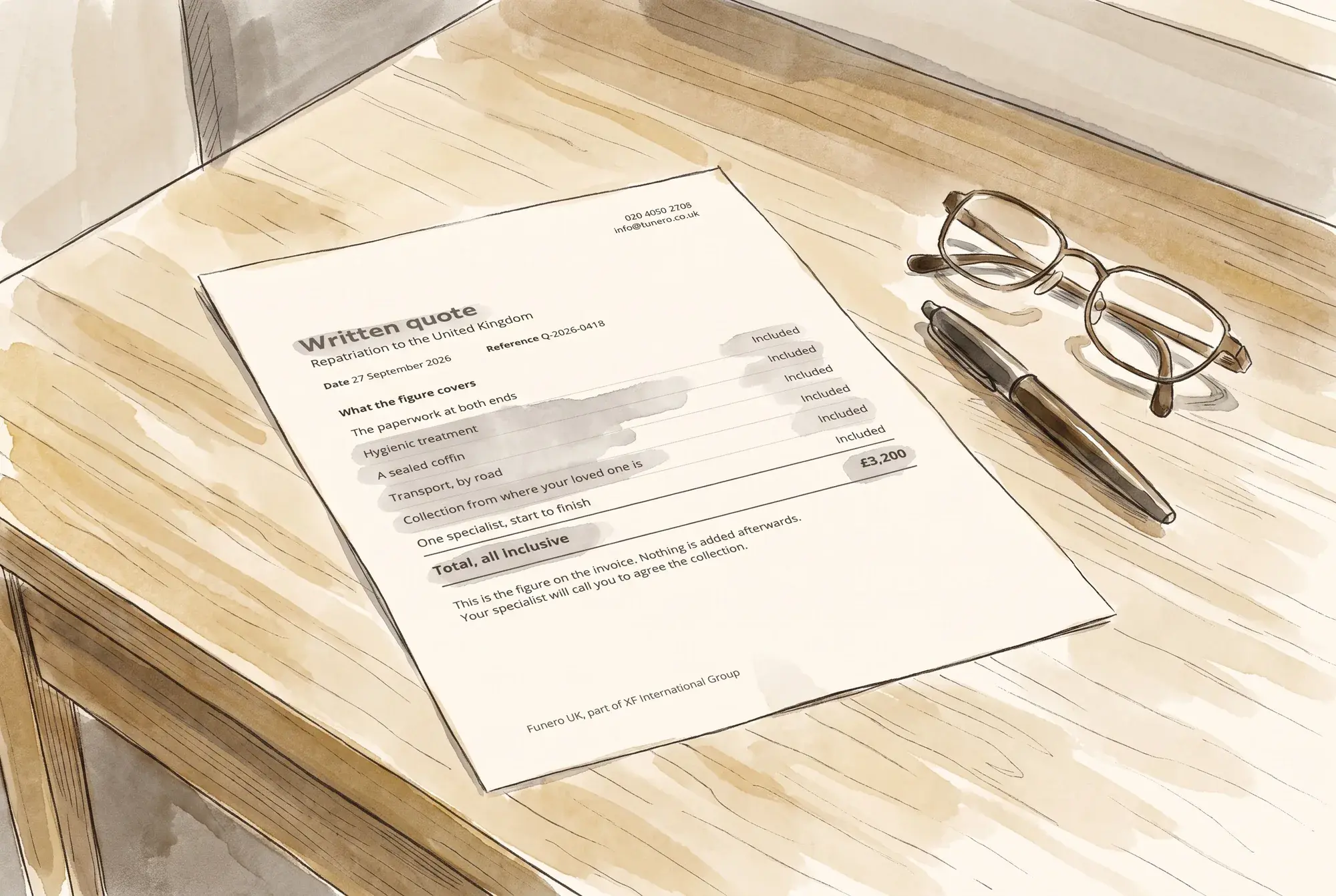
Tell us where in Spain your loved one is and whether a judge is involved, and we send a written estimate the same day.
Repatriation to and from Spain- GOV.UK, What to do after a British person dies in Spain
- GOV.UK, What to do when someone dies abroad
- GOV.UK, What to do after a British national dies abroad
- Ministerio de Sanidad, Traslado internacional de cadáveres
- Ministerio de Sanidad, Guía de consenso sobre sanidad mortuoria, julio 2025
- Ministerio de Justicia, Certificado de defunción
- legislation.gov.uk, Coroners and Justice Act 2009, section 1

Need to talk to someone?
We answer at any hour, and a call costs nothing. Tell us where your loved one is and we will tell you what happens next.
020 4559 2705


 Nigeria
 Jamaica
 Romania
 Bulgaria
 Slovakia
 France
 Germany
 Hungary