When someone dies in Dubai or the UAE: what to do
A death in the UAE runs through the police, the emirate's health authority and the British Embassy, in that order, and the next of kin is expected to make the decisions. Here is the order, the papers each office issues, and the choice between the UAE and home.


Need to talk to someone?
We answer at any hour, and a call costs nothing. Tell us where your loved one is and we will tell you what happens next.
020 4559 2705At a glance
- What it is
- The steps after a British person dies in Dubai or any other emirate, from the police report to a funeral in the UAE or in the UK.
- Who does it
- A funeral director in the UAE normally registers the death and collects the papers. The next of kin makes the decisions. The British Embassy issues a no-objection letter but does not pay or arrange.
- How long it takes
- If the death was outside a hospital, the prosecutor's release comes first. Once your loved one is released and the papers are in place, a repatriation usually takes 2 to 7 days.
Families in the UK often hear first from an employer, a landlord or the police in Dubai, and they are asked to decide things quickly from a long way off. In the UAE the next of kin is expected to make the decisions, though they can usually appoint someone to act for them. The UK has no legal definition of next of kin, so if the family is not sure who that is, or a same-sex marriage is involved, ask the British Embassy before anything is signed.
The first calls
Ring the travel insurer first if there is a policy, and the employer if your loved one worked in the UAE or was there on business. Either may already have a funeral director and cover for the repatriation, and a firm you appoint before that call may not be paid.
The British Embassy and consulates can explain the procedure in each emirate, list funeral directors, lawyers and translators, ask for updates on an investigation and advise on transferring money from family in the UK. They cannot pay any cost, investigate the death or recommend one firm. For a suspicious death, a child, or more than one death, call the embassy directly.
Registering the death, emirate by emirate
Registration in the UAE is more involved than in the UK, and a local funeral director normally does it for you. The steps are fixed:
| Step | Issued by |
|---|---|
| Report the death | The police where your loved one lived, or the station handling the case |
| Death notification | The hospital |
| Death registration letter | The police station |
| Death certificate | The emirate’s health authority, such as the Dubai Health Authority or the Department of Health in Abu Dhabi |
| Attestation of the certificate | The UAE Ministry of Foreign Affairs |
For the certificate the health authority asks for the police letter, the hospital notification, a copy of your loved one’s passport with the visa page, their Emirates ID if they had one, and photo identification for you. If your loved one is coming home, the certificate is needed before anything else can move. If the certificate is not in English, you will also pay for an official translation.
If the death was outside a hospital
Any death outside a hospital goes to the police, who arrange a post-mortem, and your loved one is released only with the permission of the prosecutor’s office. The authorities do not usually need the family’s consent for a post-mortem. The report is available to the family from the prosecutor’s office once the investigation has finished. Until the release comes, no one can give an honest date for a funeral at home.
A burial or a cremation in the UAE
A burial in the UAE is possible only if your loved one held a valid residency visa. Someone visiting on holiday can be cremated there or brought home. A Muslim burial also needs a burial permit, which the next of kin collects from the police with their passport.
Cremation is available only for non-Muslims, at three places: Al Foah Cemetery in Al Ain, Sonapur at Jebel Ali in Dubai, and the Sharjah crematorium. The police no-objection letter goes to the municipality for a cremation permit. A child under three cannot be cremated in the UAE. Ashes can travel home with you on the flight in an unsealed box, with the police letter. If a coroner in England or Wales may need to look into the death, do not choose a cremation or a burial in the UAE.
Bringing your loved one home
A funeral director in the UAE works with an international funeral director in the UK, and you sign a form allowing both to act for you. Your loved one is embalmed before the flight. In Dubai that is done at the Dubai Health Authority’s centre at Al Muhaisnah, which also issues the letter allowing transport out of the country, and every document has to reach its mortuary before your loved one does. The airline then needs the embassy’s and the police’s no-objection letters, the attested death certificate, the death notification, the embalming certificate, the cancelled passport, a UK funeral director’s letter agreeing to receive your loved one if no relative is travelling, and the flight booking, with seven copies of each.
At home, the register office where the funeral will be issues a certificate of no liability to register from the UAE certificate. If the cause of death was unknown or unnatural, the coroner for that area must investigate, and a cremation in the UK needs the coroner’s form Cremation 6. Our UAE repatriation page carries the estimate for the route in both directions.
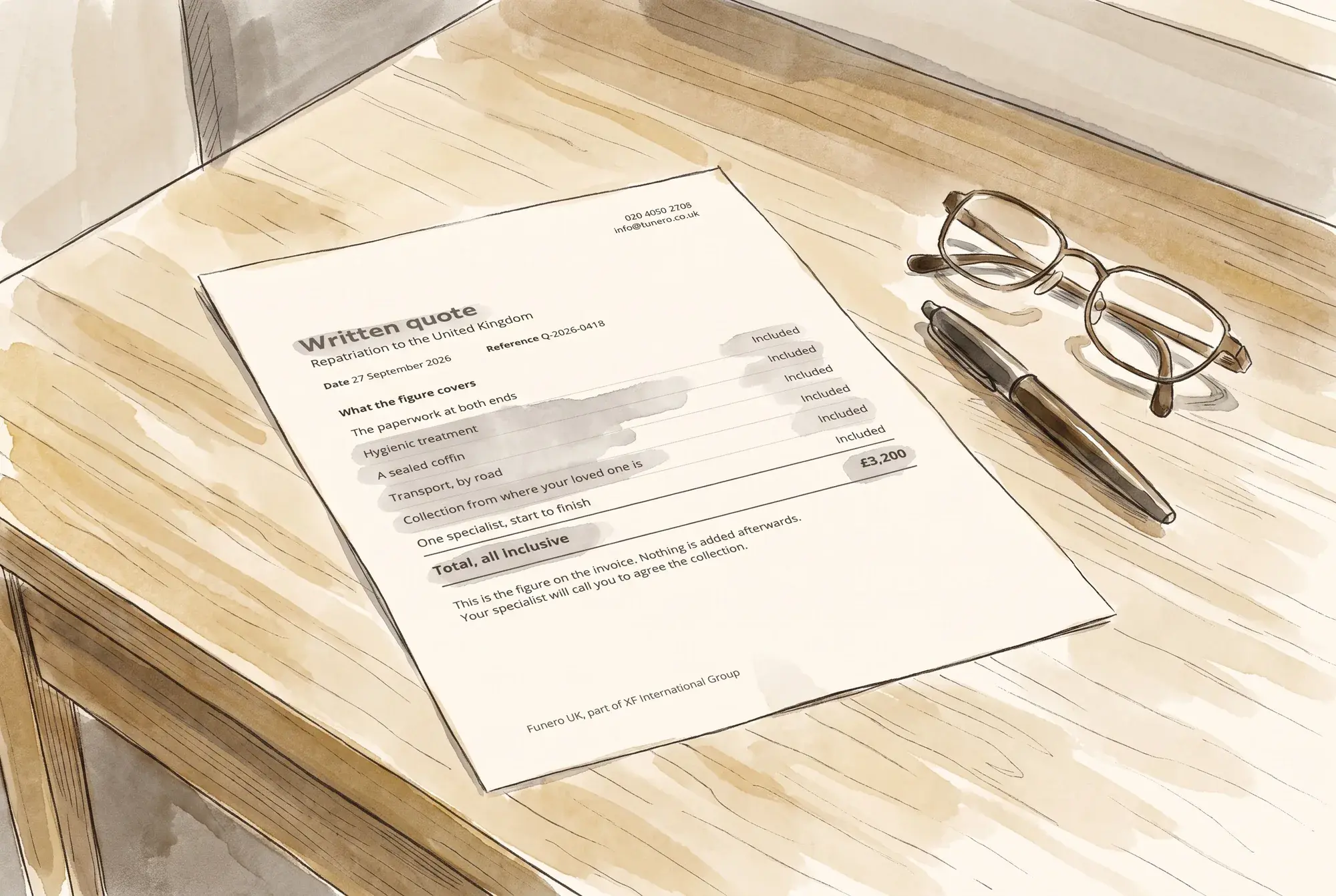
Tell us which emirate your loved one is in and whether the police are involved, and we send a written estimate the same day.
Repatriation to and from the UAE- GOV.UK, When someone dies in the United Arab Emirates
- GOV.UK, Birth, death and marriage abroad in the United Arab Emirates
- GOV.UK, What to do when someone dies abroad
- Dubai Health Authority, Embalming services at Al Muhaisnah
- legislation.gov.uk, Coroners and Justice Act 2009, section 1

Need to talk to someone?
We answer at any hour, and a call costs nothing. Tell us where your loved one is and we will tell you what happens next.
020 4559 2705



 Nigeria
 Jamaica
 Romania
 Bulgaria
 Slovakia
 France
 Germany
 Hungary