What different faiths say about cremation
Some faiths require cremation, some forbid it, and most permit it with a view. Here is what each of the main traditions in the UK holds, in its own terms, and the question to take to your own faith leader.

Need to talk to someone?
We answer at any hour, and a call costs nothing. Tell us where your loved one is and we will tell you what happens next.
020 4559 2705At a glance
- What it is
- The position of each of the main faith traditions in the UK on cremation, and on what may be done with the ashes.
- Who handles it
- Each tradition's own teaching, as its main bodies state it. Your own faith leader, for how it applies to your family.
- How long it takes
- A conversation with your faith leader before the decision, not after.
Whether cremation is allowed, required or forbidden is a question every faith has answered, and the answers are different enough that a family should know their own tradition’s before they decide. This guide is each tradition’s position as its main bodies state it, in the UK, in plain terms. It is not a ruling on anyone, and the final section says what to ask your own faith leader.
Christianity
The Church of England permits cremation and has since 1944; its canons ask that the ashes be reverently disposed of by a minister, in a churchyard or other burial ground, on land the bishop has set aside for it, or at sea, and most Anglican funerals in the UK are now cremations. The prayer book’s committal words exist in a cremation form.
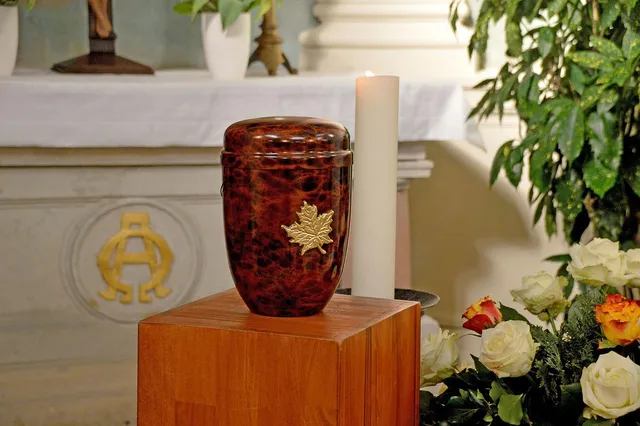
The Catholic Church permits cremation and has since 1963, preferring burial. Its 2016 instruction asks that the ashes be kept in a sacred place, a cemetery or a church, rather than at home, and not scattered or divided, and a Catholic family choosing cremation should expect the parish to ask for that. A funeral Mass can be held with the coffin present before cremation, or with the ashes afterwards.
The Orthodox churches, Greek, Romanian, Russian and the rest, traditionally do not permit cremation and hold to burial, with the coffin open at the church. Some jurisdictions will conduct a funeral for a person who was cremated where the family had no choice; the priest will say. For a repatriation to an Orthodox country, burial is the expectation.
The Free Churches, Methodist, Baptist, United Reformed and others, permit cremation without restriction and have no rule about the ashes.
The question families ask, whether the Bible forbids cremation, has no simple answer: burial was the practice of the Old and New Testaments and cremation is nowhere commanded or forbidden, and the churches’ positions are tradition and teaching rather than a text.
Islam
Islam requires burial and forbids cremation. The person is washed, shrouded and buried as soon as possible, facing Mecca, without a coffin where the country permits it and in a simple one where it does not. A Muslim family in the UK arranges a burial, often in a Muslim section of a cemetery, and for a repatriation to a Muslim-majority country the same applies with the destination’s own rules; religious and cultural requirements in a repatriation covers that.
Judaism
Orthodox Judaism requires burial and forbids cremation, with the person washed by the community’s burial society, watched until burial, and buried quickly in a plain coffin. Reform and Liberal Judaism permit cremation, and their rabbis will conduct the funeral and allow the ashes to be buried in a Jewish cemetery. A Jewish family should ask their own synagogue, because the answer depends on which.
Hinduism
Hinduism requires cremation for nearly everyone, as soon as possible, with the eldest son or another family member lighting or beginning the cremation and the family present; in the UK that means an attended cremation, and crematoria that serve Hindu communities let the family witness the coffin being placed in the cremator and, at some, a family member begins it. The ashes are scattered on a river, ideally the Ganges, and taking ashes abroad covers taking them to India.
Sikhism
Sikhism requires cremation, with the family present, prayers from the Guru Granth Sahib, and the ashes scattered in flowing water. No monument is raised. As with Hindu families, this is an attended cremation, and a direct cremation does not fit.
Buddhism
Buddhism permits both, with cremation traditional in most Buddhist countries and the choice left to the family. Monks or a lay leader may chant at the funeral, and the ashes may be kept, buried or scattered.
Humanists and people of no faith
No rule of any kind, and the choice is wholly the family’s. A humanist celebrant will conduct a funeral for either, and cremation or burial sets out the practical grounds for a family with no faith rule to guide them.
What to ask your own faith leader
Not whether cremation is permitted, which this page answers in general, but what your family may do in this case. Faith leaders answer that question for particular families every week, and the answer is often more accommodating than the general rule: a Catholic parish that will keep the ashes in its columbarium, an Orthodox priest who will conduct the funeral for a person cremated abroad, a Reform rabbi who will bury the ashes. Ask before the decision, not after, and if the answer is cremation and a direct one fits, is a direct cremation right for us is the next question.
For what a cremation actually involves, whichever tradition permits it, direct cremation step by step follows one from the first call to the ashes.
If your tradition permits cremation and a direct one fits, ours is £1,295, fixed. If it does not, we arrange burials and repatriations too, and we will say so plainly.
Direct cremation, £1,295 fixed- Church of England, Canon B 38
- Catholic Church, Ad resurgendum cum Christo, 2016
- Muslim Council of Britain, Muslim burial resources
- Public Health England, Faith at end of life
- Federation of Burial and Cremation Authorities, FAQs
- Babworth Crematorium, Guide to services

Need to talk to someone?
We answer at any hour, and a call costs nothing. Tell us where your loved one is and we will tell you what happens next.
020 4559 2705