Día de los Muertos in Mexico
On the first two days of November, Mexican families welcome their dead home with altars, marigolds, food and music. This is what the Day of the Dead is, where it comes from, and what each part of it means.

Need to talk to someone?
We answer at any hour, and a call costs nothing. Tell us where your loved one is and we will tell you what happens next.
020 4559 2705At a glance
- What it is
- The Mexican festival of the dead, held on 1 and 2 November, and its meaning.
- Who it is for
- Mexican families, at home and in the diaspora, and increasingly anyone who has lost someone and likes the idea.
- How long it takes
- Two days a year, with a week of preparation.
In Mexico, death is not a subject to be avoided, it is met with colour, music, memory, and love. Día de los Muertos, celebrated on 1st and 2nd November each year, is one of the world’s most distinctive cultural traditions: a time when families believe the spirits of the dead return for a brief reunion with the living.
Mexican Mourning: Before the Holiday
Long before Día de los Muertos, Mexican funeral customs centre on community support. When someone dies, the family typically organises a wake lasting two to three days, during which relatives and close friends gather to pray and share memories of the departed.
After the funeral, the family and guests share a meal, it is customary for each person to bring food or offer a monetary contribution to help cover costs. For the nine days following the funeral, prayers are recited in a practice known as novena, common throughout Latin America, believed to guide the soul towards Heaven.
Many families maintain a home altar with photographs and personal items of their deceased relatives year-round, keeping memory alive as part of daily life.
Historical Roots of Día de los Muertos
The holiday has deep pre-Columbian roots. The Aztecs and other Mesoamerican cultures held rituals honouring their dead ancestors, rituals that were later woven together with Catholic practices brought by Spanish colonisers. The result is a syncretic tradition that now spans two days:
- 1st November, Día de los Inocentes (Day of the Innocents), also called Día de los Angelitos, honouring deceased children.
- 2nd November, Día de los Muertos, commemorating adults who have passed.
Altars, Offerings, and Symbols
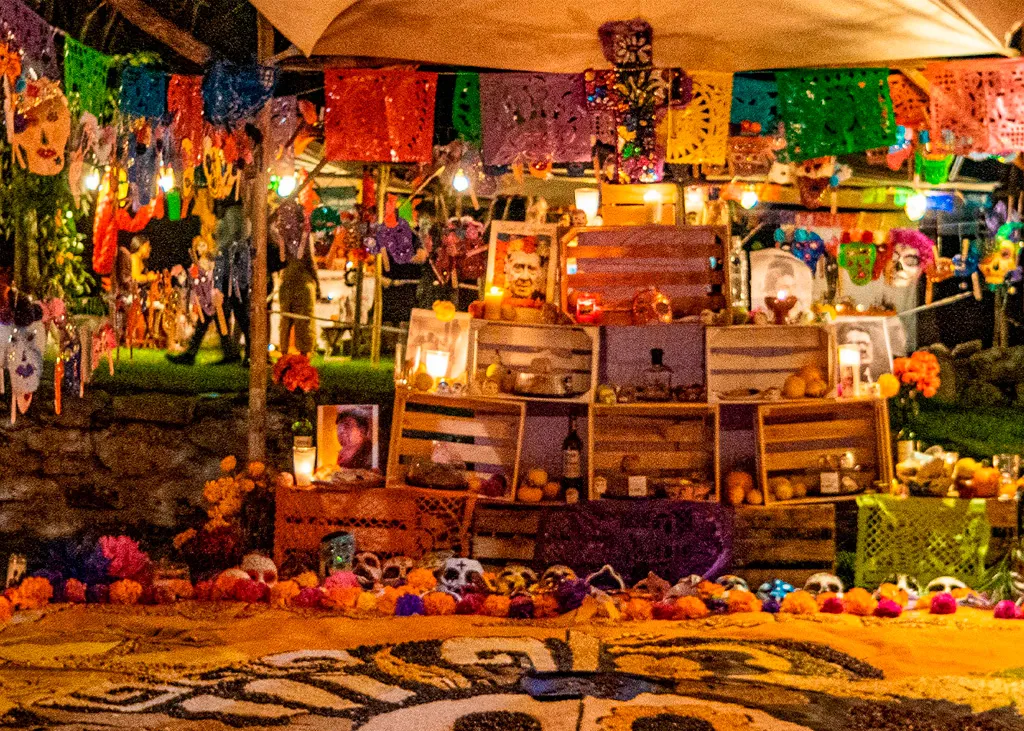
At the heart of the holiday are ofrendas, altars set up in homes and cemeteries, decorated with marigolds, candles, photographs, and personal belongings of the person who has died. Families place offerings of food, drink, and the favourite items of those they are honouring, believing these guide the spirits back for their annual visit.
The key symbolic elements include:
- Marigolds (cempasúchil): Known as the “flower of the dead,” their bright colour and strong scent are believed to attract and guide the souls of the person who has died.
- Sugar skulls (calaveras): Ornate, decorated skulls that represent the person who has died and serve as a reminder of the sweetness of life.
- Pan de muerto: Traditional sweet bread, often shaped with bone decorations, symbolising the cycle of life and death.
- Papel picado: Colourful paper cut-outs representing the fragility of life, used to decorate altars and public spaces.
Celebrations and Community
During the two days, families gather at cemeteries to clean and decorate graves, often spending the night in celebration. Music, dancing, and storytelling create an atmosphere of festivity rather than mourning. Public squares and streets are adorned with decorations, parades, and shared altars, bringing communities together in collective remembrance.
In some regions, people paint their faces to resemble calaveras, and traditional dances such as the Danza de los Viejitos and performances featuring La Catrina, a skeletal figure dressed in elegant attire, add further richness to the celebrations.
A Tradition That Has Spread Worldwide
While rooted in Mexican culture, Día de los Muertos has gained recognition globally: UNESCO placed it on its list of the intangible cultural heritage of humanity in 2008. Cities with large Mexican-American communities, such as Los Angeles and San Antonio, host large-scale celebrations. Films such as Pixar’s Coco have introduced its imagery and spirit to worldwide audiences, reinforcing its message that those we love are not truly gone as long as they are remembered.
If you are interested in how different cultures mark death and remembrance, you may also enjoy reading about funeral traditions in Africa or a unique celebration of life in Madagascar.
If you like the idea of a day for your own dead, grief at Christmas and on the first anniversaries is about making one.
Grief at Christmas and on the first anniversaries- UNESCO, Indigenous festivity dedicated to the dead
- Wikipedia, Day of the Dead
- Wikipedia, Novena

Need to talk to someone?
We answer at any hour, and a call costs nothing. Tell us where your loved one is and we will tell you what happens next.
020 4559 2705

 Nigeria
 Jamaica
 Romania
 Bulgaria
 Slovakia
 France
 Germany
 Hungary