What a body repatriation costs
Choose where your loved one is and where they are going, and you will see the estimate, what it covers and how long it usually takes. Every figure is an estimate. For a fixed figure, ask us for a written quote.
Where is your loved one?
One end is always the United Kingdom. Choose the other country, and swap the two if your loved one is going home from here rather than coming to us.


Estimated, Romania to the UK, all inclusive
£2,700
Usually 2 to 7 days
What it covers
- All the paperwork required
- Hygienic treatment
- A sealed coffin
- Transport, by road or by air
- Collection from the hospital or mortuary
- One specialist, start to finish
A direct cremation is a fixed price
It is £1,295 for every family, agreed on the first call, and it is the one price on this site that is not an estimate. Two things can be added to it, and nothing else is.
- A private viewing at the chapel of rest£150
- Urgent collection from a home£250
Fixed price, all inclusive
£1,295
The ashes back within 7 to 10 days
What it covers
- Collection from a home, hospice, hospital or care home
- Care before the cremation, in a private mortuary
- The coffin
- The cremation fee
- Every form and permission
- The ashes returned to you
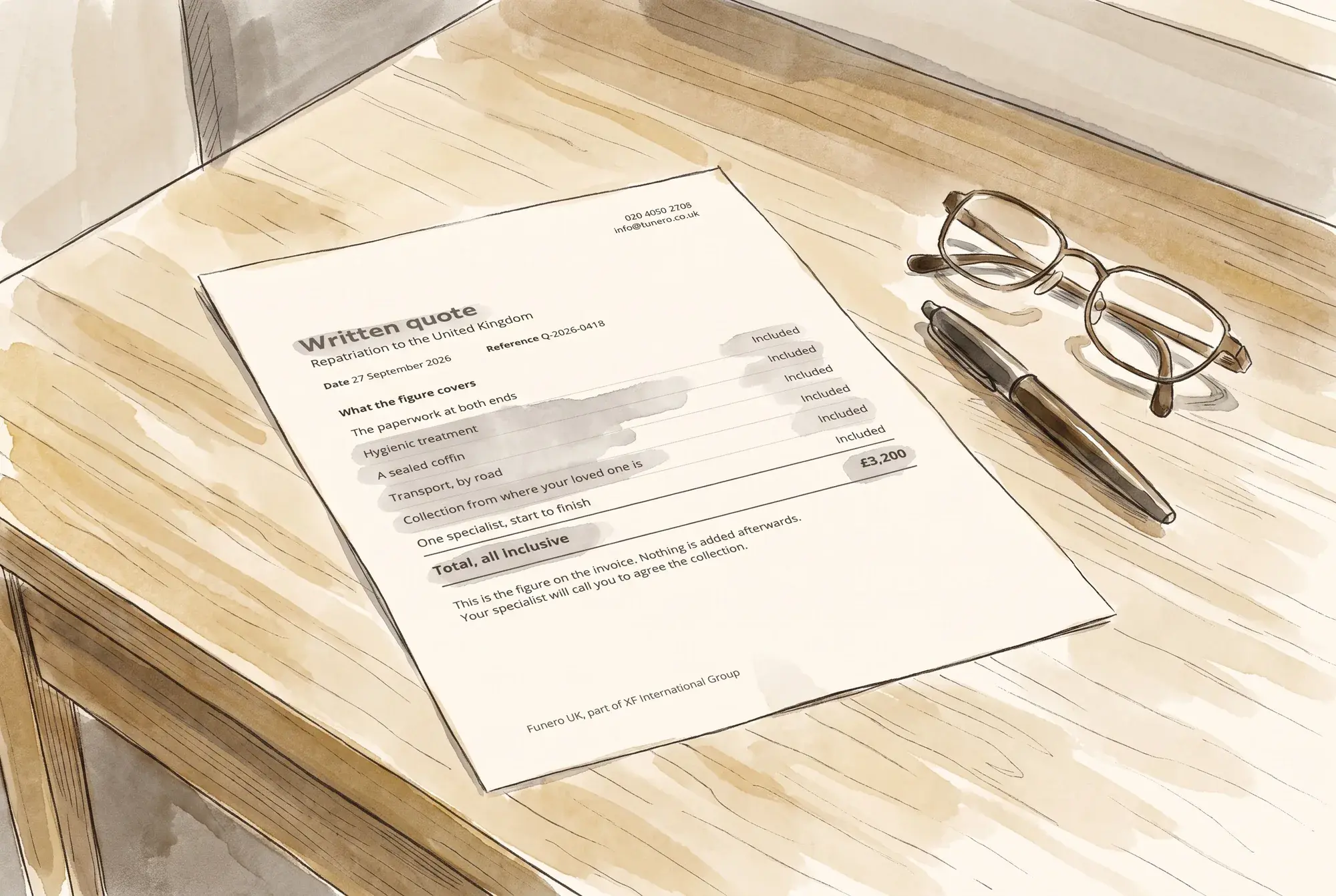
Every repatriation figure on this page is an estimate. Tell us your case and we will send you a firm figure in writing.
Every country and its estimate
Most countries share a band, set by how far your loved one travels and what the paperwork asks for. The routes we make most often carry their own figure. This is the whole table, so you can find your country without the calculator; each country page shows the figure for each direction.
- Ireland
 ~£1,800
- Slovakia
 ~£2,400
- Georgia and Poland

 ~£2,500
- Bulgaria, Czech Republic and 9 more



 ~£2,700
Bulgaria, Czech Republic, France, Germany, Hungary, Lithuania, Moldova, North Macedonia, Romania, Serbia, Ukraine
- Greece
 ~£2,800
- Egypt and Italy

 ~£3,000
- Albania
 ~£3,100
- Portugal and Spain

 ~£3,500
- Ghana, Jamaica and 1 more


 ~£3,800
- Bangladesh, Canada and 3 more



 ~£4,000
Bangladesh, Canada (~£6,500 to the UK), India, Pakistan, Russia (~£4,500 from the UK)
- Australia
 ~£4,400
- Afghanistan, Brazil and 1 more


 ~£4,500
- China
 ~£6,500
- Nearest Europe, by road


 ~£2,800
Belgium, Luxembourg, Netherlands
- Europe



 ~£3,200
Andorra, Armenia, Austria, Belarus, Bosnia and Herzegovina, Croatia, Denmark, Estonia, Finland, Iceland, Latvia, Liechtenstein, Monaco, Montenegro, Norway, San Marino, Slovenia, Sweden, Switzerland, Vatican City
- Mediterranean islands

 ~£3,500
- Africa, the Middle East, south and central Asia



 ~£4,500
Algeria, Angola, Azerbaijan, Bahrain, Benin, Bhutan, Botswana, Burkina Faso, Burundi, Cameroon, Cape Verde, Central African Rep., Chad, Comoros, Congo, Cote d'Ivoire, Djibouti, DR Congo, Equatorial Guinea, Eritrea, Eswatini, Ethiopia, Gabon, Gambia, Guinea, Guinea-Bissau, Iran, Iraq, Israel, Jordan, Kazakhstan, Kenya, Kuwait, Kyrgyzstan, Lebanon, Lesotho, Liberia, Libya, Madagascar, Malawi, Maldives, Mali, Mauritania, Mauritius, Morocco, Mozambique, Myanmar, Namibia, Nepal, Niger, Oman, Palestine, Qatar, Rwanda, Sao Tome and Principe, Saudi Arabia, Senegal, Seychelles, Sierra Leone, Somalia, South Africa, South Sudan, Sri Lanka, Sudan, Syria, Tajikistan, Tanzania, Togo, Tunisia, Turkey, Turkmenistan, UAE, Uganda, Uzbekistan, Yemen, Zambia, Zimbabwe
- South east and east Asia, the Caribbean, Latin America



 ~£6,000
Antigua & Barbuda, Argentina, Bahamas, Barbados, Belize, Bolivia, Brunei, Cambodia, Chile, Colombia, Costa Rica, Cuba, Dominica, Dominican Republic, Ecuador, El Salvador, Grenada, Guatemala, Guyana, Haiti, Honduras, Hong Kong, Indonesia, Japan, Laos, Macao, Malaysia, Mexico, Mongolia, Nicaragua, North Korea, Panama, Paraguay, Peru, Philippines, Singapore, South Korea, St Kitts & Nevis, St Lucia, St Vincent, Suriname, Taiwan, Thailand, Timor Leste, Trinidad & Tobago, Uruguay, Venezuela, Vietnam
- Australia, New Zealand and the Pacific



 ~£8,000
Fiji, Kiribati, Marshall Islands, Micronesia, Nauru, New Zealand, Palau, Papua New Guinea, Samoa (western), Solomon Islands, Tonga, Tuvalu, Vanuatu
What the estimate covers
Every repatriation figure on this page covers the six things below. What sits outside it is the funeral itself, any fee a third party sets, an urgent collection from a home, and collection from the airport when a route flies; we tell you about those before anything is agreed.
-
All the paperwork required
The coroner’s permission, the free from infection certificate, our declaration as funeral director, and an embalming certificate, apostille or translation wherever the route asks for one. We obtain all of it.
-
Hygienic treatment
Carried out before your loved one travels, in the country they are in, to the standard the carrier and the destination require.
-
A sealed coffin
A coffin that meets the requirements for the route and for the country at the other end.
-
Transport, by road or by air
Most repatriations run by road. We go by air only where the road is not possible, and you know which before anything is booked.
-
Collection from the hospital or mortuary
An urgent collection, usually from a home, is priced separately. By road we drive on to the funeral director your family has chosen; by air, collection from the airport at the destination is an optional extra.
-
One specialist, start to finish
The same person answers the phone from the first call to the day your loved one is home.
What moves the figure
The band is where we start. Five things move it from there, and we tell you which of them apply to your case on the first call.
| What changes | What it means for the figure |
|---|---|
| How far your loved one has to travel | Nearest Europe by road is the lowest figure we publish. A long route with a flight at the end is the highest. |
| What the country’s offices ask for | A legalisation, a consular authorisation or a certified translation. Each one takes time, and some carry a fee set by someone else. |
| Whether the death is still under investigation | A coroner or a prosecutor releases your loved one first. We price that case properly rather than guess at it. |
| Ashes rather than a coffin | If your loved one has been cremated, or will be, the route is simpler and it costs less. |
| Where your loved one is in the country | A collection a long way from the nearest city adds a road leg at that end. |
Who pays, and in what order to check
Usually the family. The British government does not pay to bring a citizen home or to send anyone abroad. What can step in is below, in the order to check it, because the first one has a deadline.
| Who can pay | What to know |
|---|---|
| A travel insurance policy | The biggest source of money for a repatriation to the UK. Ring the insurer’s assistance line before you sign with anyone: most policies pay only for a repatriation they have approved, and a claim reported late can be refused. |
| An employer’s policy | If your loved one died while posted abroad, or was working in the UK away from home, their employer may hold a group policy that covers it. Ask HR for the policy wording. |
| The consulate, or the community | A few countries help their nationals’ families, usually with documents and advice rather than money, and religious and community organisations in the UK sometimes raise funds. Only the consulate in London can tell you what it offers. |
| The estate | Funeral costs, and a repatriation is one, are a first charge on the estate. A bank may release money from a frozen account against our invoice before probate, but it does not have to, so this is the last one to rely on. |
| What does not pay | The Funeral Expenses Payment does not cover a repatriation. Three charities the Foreign Office lists can help some families: the JackTheLad Foundation for a person aged 16 to 30 who died in an accident overseas, the Kevin Bell Repatriation Trust for Northern Ireland and Ireland, and the Repatriation Services Trust for Wales. |
How to keep the cost down
Five things lower the figure honestly. A quote that is cheap because it leaves a line out is not one of them: the missing line arrives later, as a second invoice.
| What helps | Why it saves |
|---|---|
| Road instead of air, where the route allows | For most of Europe the road costs less, has fewer handovers and no airline schedule, and it is what we do by default. |
| A standard repatriation coffin | The sealed coffin a border requires is included in our estimate. An upgraded coffin is the single line that adds most to a quote, and a family can often buy the coffin they want at the destination for less. |
| Cremation before travel, where your family and faith allow it | Ashes need a fraction of the documents and cost a fraction of a coffin’s transport. It is not right for every family or every faith, and it is a real choice. |
| The documents done once, in the right order | A certificate translated before it is legalised has to be translated again, and a late notice to the coroner adds days of chapel of rest fees. The cheapest repatriation has no repeats. |
| A complete written quote | Ask any firm, us included, for a quote that lists every item, says whether the coffin is included, and names the receiving funeral director at the destination and what they charge. Two complete quotes usually differ by a few hundred pounds. |
Questions about what it costs
It depends on the country. The table above shows our estimate for every country, about £1,800 for Ireland at the near end and more for the long-haul routes that fly. An estimate can come in lower as well as higher. Tell us where your loved one is and we put your figure in writing on the first call.
Because part of the figure is not ours to set. What a country’s offices charge for an authorisation or a legalisation, how far your loved one is from the nearest city, and whether a coroner is still involved all move it. We work those out with you on the first call and put the figure in writing, and the written figure is the one on the invoice. A direct cremation is the one thing on this site sold at a fixed price.
Usually the family. A travel policy often covers a death abroad, some employers cover a death that happens on a posting, and the estate can pay once probate is granted. We help you check the policy and make the claim, so you only pay for what it does not cover. The usual exclusions are in does travel insurance cover repatriation.
Yes. The band is the same in both directions, because the work is the same: the papers at both ends, the hygienic treatment, the coffin, the collection and the transport. What changes is which set of offices issues which document, and we deal with both.
Most of the figure is work at both ends rather than the transport itself: the documents in two countries, the hygienic treatment, a coffin that meets the rules of the route and of the country at the other end, and the collection. Most of our repatriations go by road. Where a route needs a flight, the air cargo costs more, which is why the longest routes sit in the highest bands.
The funeral itself, whether that is a burial, a cremation or a service, any fee somebody else sets, such as a consular charge or a crematorium fee at the other end, an urgent collection from a home, and collection from the destination airport when a route flies, which we arrange on request. We name those before anything is agreed rather than after. Where your family has chosen a funeral director, the estimate ends at their door.

By road or by air: how the transport is chosen

Does travel insurance cover repatriation, and what to do first

What documents does a repatriation need

Someone answers, any hour of the day
Tell us where your loved one is and we will tell you what happens next, and what it costs.

 Hungary