Taking ashes to India from the UK: the papers and the rites
India asks for more than most countries before ashes arrive. Here is the ashes certificate from the High Commission, what the airline and the arrival airport expect, the customs at Haridwar and Kiratpur Sahib, and the places in the UK where families hold the immersion instead.

Need to talk to someone?
We answer at any hour, and a call costs nothing. Tell us where your loved one is and we will tell you what happens next.
020 4559 2705At a glance
- What it is
- Carrying or sending a loved one's ashes from the UK to India for the immersion, and the alternatives here.
- Who does it
- The crematorium issues the certificate of cremation. The High Commission of India, through VFS Global, issues the ashes certificate. The airline and the health officer at the arrival airport check them.
- How long it takes
- The UK papers exist within days of the cremation. The ashes certificate is the step that sets the date, so apply as soon as the certificate of cremation is in your hands.
For a Hindu or Sikh family, the cremation in the UK is often only half of what has to happen. The ashes are taken to flowing water, and for many families that means the Ganges or the Sutlej. The UK asks for nothing to take ashes out of the country. India asks for a certificate from its High Commission in London before they arrive, and that certificate, not the flight, is usually what sets the date.
The papers from the UK
The crematorium issues the certificate of cremation once the cremation has taken place; ask for the original, and ask whether it issues a version for use overseas. You also need a certified copy of the death certificate from the register office, and a letter from the funeral director stating whose ashes the urn holds and that it holds nothing else.
The ashes certificate from the High Commission
The High Commission of India takes applications for an ashes certificate through VFS Global. Its checklist asks for:
| Document | Notes |
|---|---|
| Application form | Filled in by the informant, usually the next of kin |
| Death registration form | Only if your loved one held an Indian passport, or an OCI or PIO card |
| Death certificate | A copy, with the certificate number and the signature clear |
| Certificate of cremation | A copy |
| Funeral director’s certificate | Name, age, date, time and cause of death, and what the urn contains |
| Last passport held | A copy |
| Indian passport or OCI or PIO card | The original, for cancellation |
| Proof of Indian origin | With a signed request letter from the informant |
The fee and the processing time are set by the High Commission and change, so check them on the day you apply. The permit can take longer than families expect, and it is the legal way for ashes to enter India, so apply before you book the flight to the river. If the family cannot find the Indian passport or the OCI card, say so before you apply, because it is the document that most often holds an application up.
On the flight
Air India accepts ashes in the cabin or in the hold; other airlines set their own rules, and taking ashes on a plane compares them. Carry the urn in your hand luggage if you can. Security X-rays the container and does not open it, so use a temporary travel urn of wood, plastic, cardboard or ceramic without lead lining. If the image is unclear, Air India says the urn may have to go in the hold after a trace test. Keep every paper with the urn, in the original and with copies.
At the airport in India
India’s port health rules ask for at least 48 hours’ notice, by email, to the health officer at the airport of arrival, and for the ashes to arrive in a sealed urn with the certificate endorsed by India’s mission in the UK. Air India points travellers to the Health Ministry’s eCARe portal, where the current requirements and the application are. Allow time at arrivals: the urn stays at the airport until the health officer releases it in writing.
At the river
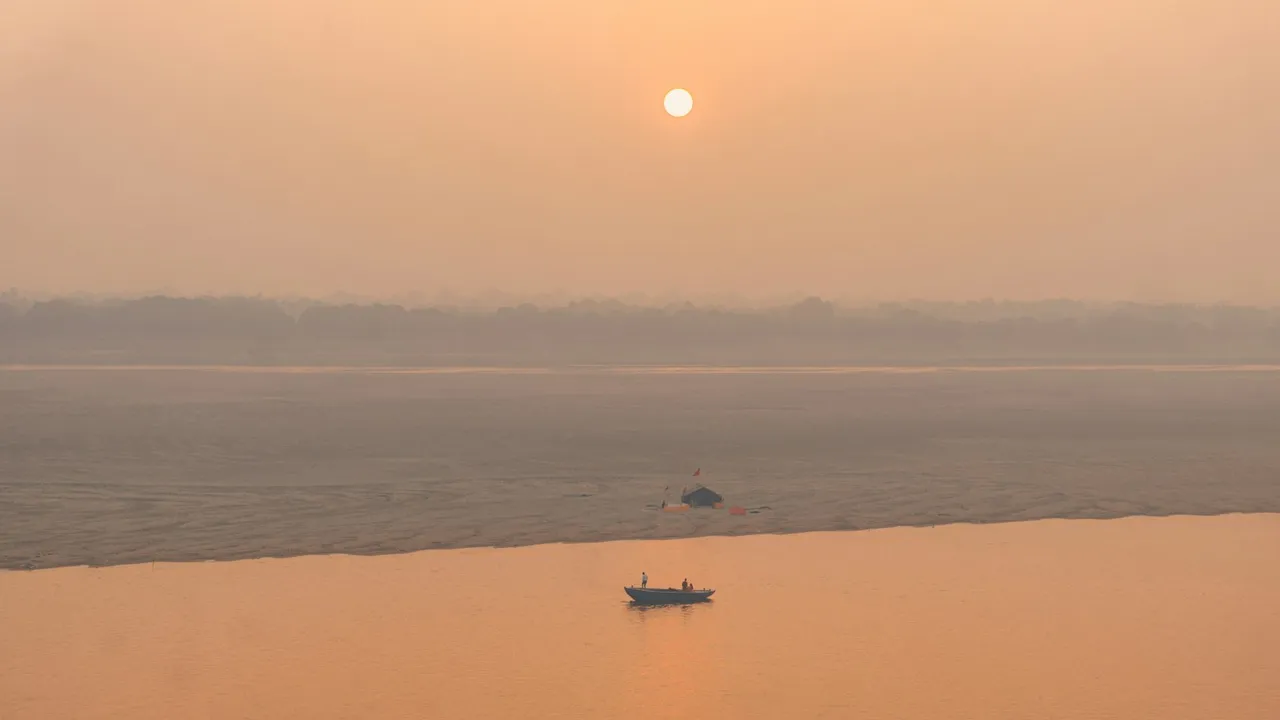
Many Hindu families immerse the ashes in the Ganges at Haridwar, at the ghat called Har Ki Pauri. Where the Ganges is not possible, the faith generally allows another river or body of water, so some families choose a river near the family home.
For Sikh families, the ashes are taken to flowing water once the sehaj path is complete, most often at Gurdwara Patalpuri Sahib in Kiratpur, on the Sutlej. Families queue from early morning at the registration office beside the asth ghat, and the gurdwara issues a certificate after the immersion.
The immersion in the UK instead
Some families hold the immersion here, sometimes keeping a small portion of the ashes to take to India later. The Environment Agency does not need to give permission if its guidance is followed in full: choose a place away from buildings, swimmers and marinas, at least 1 km upstream of any point where water is taken for supply, release the ashes close to the surface, and put nothing else in the water, no wreaths and no keepsakes. Stretches of the Soar in Leicester and of other rivers have been used with the agreement of the local authorities; your mandir or gurdwara will know what is arranged near you. A portion kept for India needs the same papers as the whole. Scattering ashes at sea needs no licence.
If the cremation is still to be arranged, direct cremation step by step sets out how the certificate of cremation comes to you.
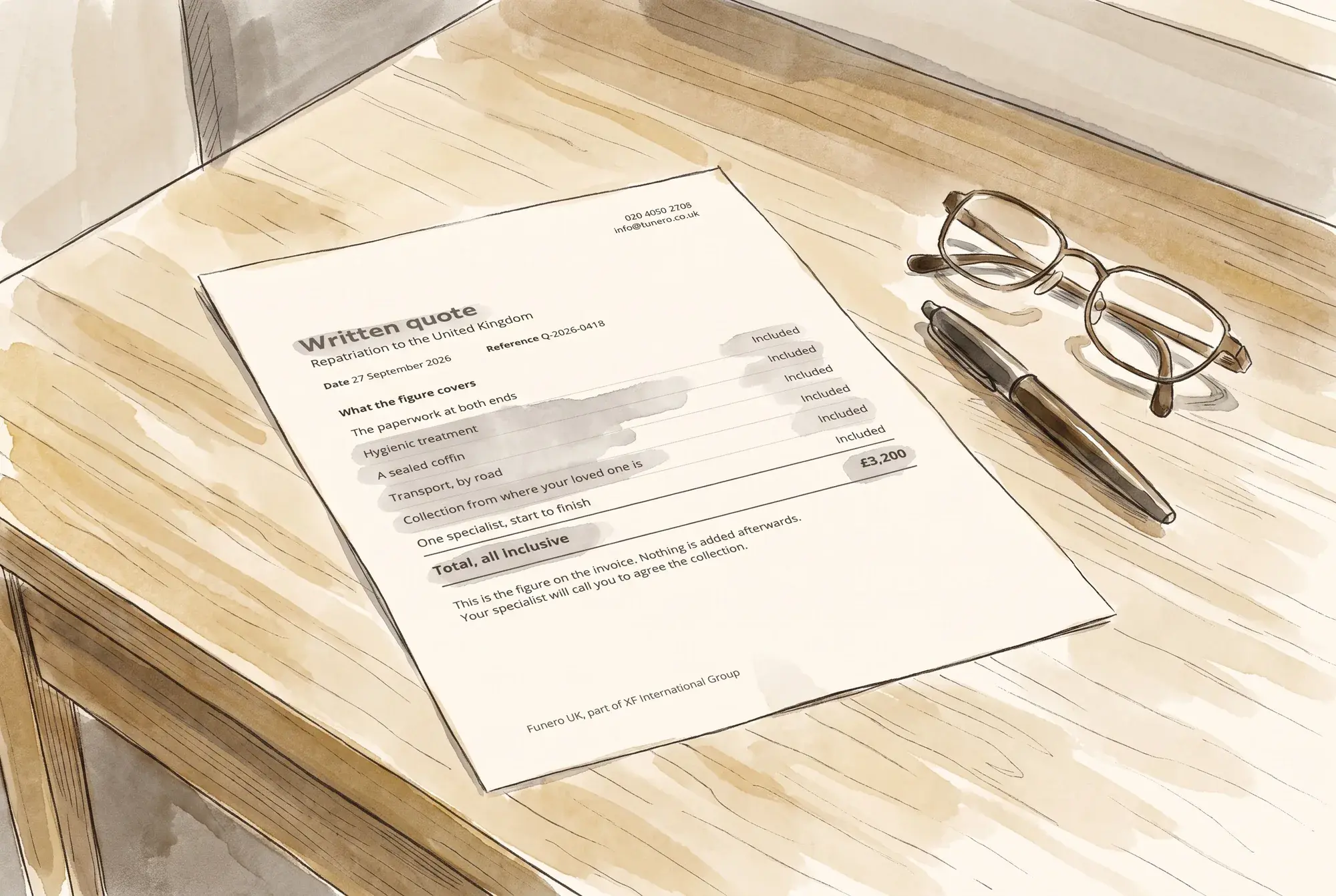
Tell us where the ashes are going and the day the family has in mind, and we send a written quote for the papers, the travel urn and, if nobody can fly, sending them to India by air freight.
Ashes repatriation, to and from the UK- GOV.UK, What to do if someone dies abroad
- VFS Global for the High Commission of India, Ashes certificate checklist
- Ministry of Health and Family Welfare, India, port health rules for human remains and ashes
- Air India, Special baggage guidelines
- Environment Agency, Scattering ashes in rivers

Need to talk to someone?
We answer at any hour, and a call costs nothing. Tell us where your loved one is and we will tell you what happens next.
020 4559 2705



 Nigeria
 Jamaica
 Romania
 Bulgaria
 Slovakia
 France
 Germany
 Hungary