When someone dies in Thailand: what to do
A death in Thailand runs through the hospital or the police, the district office and the British Embassy in Bangkok, and no mortuary releases your loved one without the embassy's letter. Here is the order, who counts as next of kin there, and the choice between a cremation in Thailand and the route home.


Need to talk to someone?
We answer at any hour, and a call costs nothing. Tell us where your loved one is and we will tell you what happens next.
020 4559 2705At a glance
- What it is
- The steps after a British person dies in Thailand, from the hospital or police report to a cremation there or a funeral in the UK.
- Who does it
- The district office (amphur) issues the death certificate. The British Embassy Bangkok issues the letter that releases your loved one. A funeral director in Thailand and one in the UK work together on a repatriation.
- How long it takes
- A post-mortem is normal for a foreign national, and the release waits for the cause of death. Once your loved one is released and the papers are in place, a repatriation usually takes 2 to 7 days.
Families in the UK often hear first from a hospital, a partner or a friend in Thailand, and are asked to settle bills and sign forms from a long way off. Thailand has its own rule on who decides: the next of kin there is the spouse, a child over 20 or a parent. Anyone else, including a partner your loved one was not married to, needs that person’s written authorisation before they can make arrangements.
The first calls
Ring the travel insurer first if there was a policy. It may cover the repatriation and already work with funeral directors, and a firm you appoint before that call may not be paid. Then ring a UK funeral director who repatriates from Thailand rather than the offices there one by one. We work with a partner funeral director in Thailand, so you give us what you know, and we coordinate the hospital, the police and the embassy through them. If your loved one died outside a hospital, the death goes to the local police, whose report is needed for everything that follows.
From the UK, the Foreign, Commonwealth & Development Office answers on 020 7008 5000 at any hour. For a child, more than one death, a suspicious death or a case of murder or manslaughter, call the British Embassy in Bangkok on +66 (0) 2 305 8333. The embassy can explain the local procedure and list funeral directors and translators. It cannot pay any cost, investigate the death, recommend one firm, or register the death in Thailand for you.
The papers, in the order they come
| Step | Issued by |
|---|---|
| Confirmation of death | The hospital, if your loved one died in hospital |
| Police report | The local police, if the death happened anywhere else |
| Death certificate, in Thai | The local district office (amphur) |
| Letter releasing your loved one | The British Embassy Bangkok |
| Certified English translation | A translator in Thailand |
| Post-mortem report, in Thai | Usually around 45 business days after the death |
The hospital’s confirmation is not a death certificate. The death still has to be registered at the district office, in hospital or not. The embassy does not translate or check translations, so the English version comes from a translator in Thailand, and GOV.UK suggests having it certified by the Thai Ministry of Foreign Affairs.
The post-mortem
A post-mortem is normally required in Thailand when the person who died was not Thai, though a death in hospital with a clear cause can be an exception. Small samples of organs can be kept for tests without the family’s consent, and you will not automatically be told. A cremation or a repatriation can go ahead once the Thai authorities are content that the cause of death is established and no further examination is needed. Until then, no one can give an honest date for a funeral at home.
The embassy’s letter
No hospital or mortuary in Thailand releases your loved one without a letter from the British Embassy Bangkok, whether for a cremation there or the route home. The next of kin applies online with their passport, proof of the relationship, such as a marriage or birth certificate, and the hospital confirmation, the police report or the district office certificate. Someone acting for them adds the next of kin’s written authorisation. The letter is collected at the embassy or posted to an address in Thailand, so a funeral director in Thailand usually applies for it on the family’s behalf.
Any hospital bill has to be paid before your loved one is released. If nobody makes arrangements, usually within 30 days, the local authorities hold a pauper’s burial, so this decision cannot wait long.
A cremation in Thailand
Thailand is a Buddhist country and cremation is the usual choice there; a burial is rare, expensive and hard to arrange for a foreigner. Leaving Thailand with the ashes, you show the death certificate and the certificate of cremation, and on arrival you fill in the standard customs form. The UK asks for no permit. Tell the airline before you fly, and carry the ashes in a container that can be X-rayed. If nobody can travel, we bring them home by air freight; ashes repatriation sets out how.
If a coroner in England or Wales may need to look into the death, do not choose a cremation in Thailand. An inquest cannot take place once your loved one has been cremated abroad.
Bringing your loved one home
A funeral director in Thailand works with an international funeral director in the UK, and you sign a form allowing both to act for you. Before the flight your loved one is embalmed, and the repatriation needs the district office death certificate, the embalming certificate, a certificate permitting the transfer and the certified translation, and Thai customs asks for the originals with two copies of each, the passport and the air waybill.
At home in England or Wales, the register office where the funeral will be issues a certificate of no liability to register from the Thai certificate. If the cause of death was unknown, violent or unnatural, the coroner for that area investigates, and a cremation in the UK needs the coroner’s form Cremation 6. In Scotland, the Death Certification Review Service takes that role. Our Thailand repatriation page carries the estimate for the route in both directions.
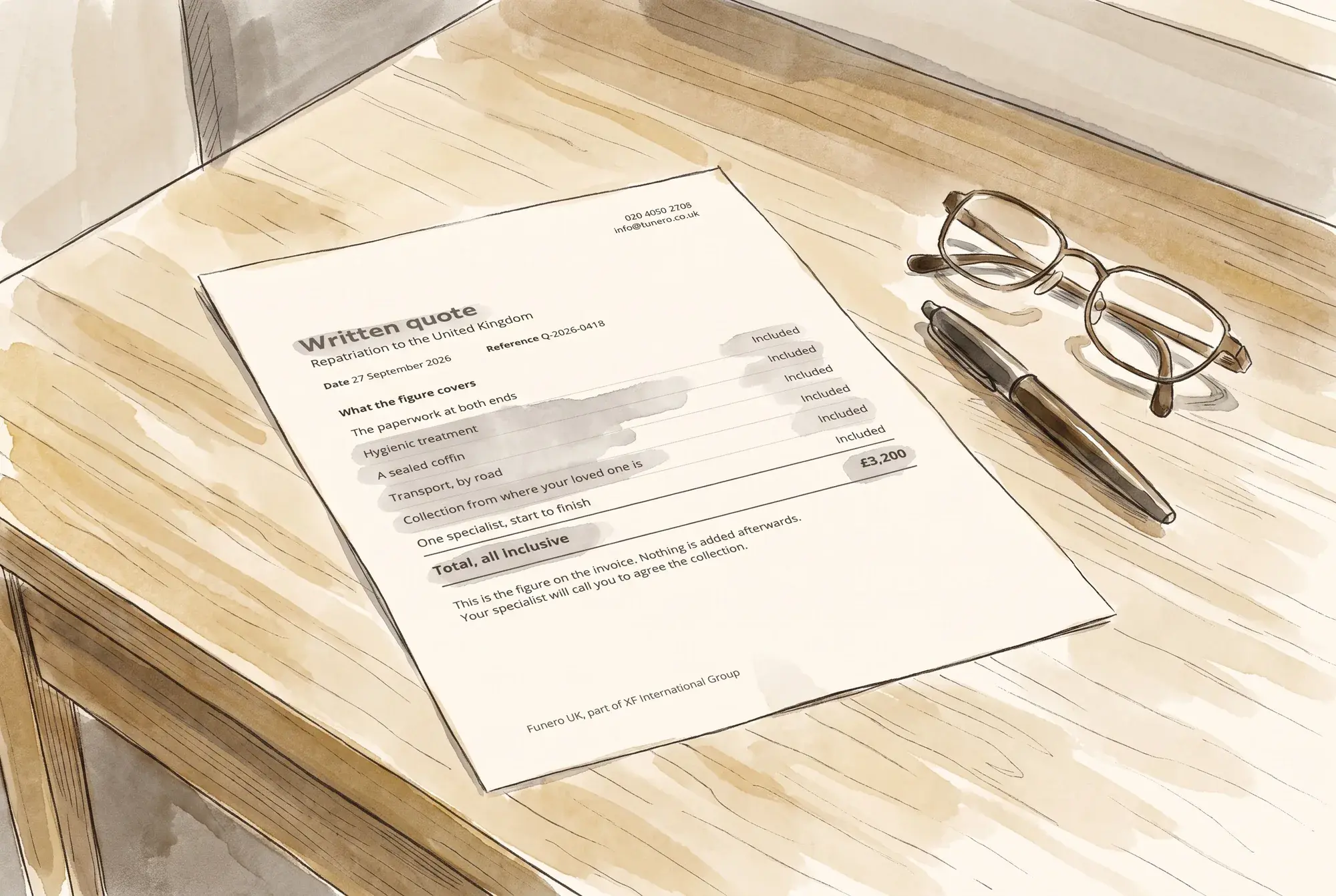
Ring us with what you know so far. We coordinate with our partner funeral director in Thailand and send a written estimate the same day.
Repatriation to and from Thailand- GOV.UK, When someone dies in Thailand
- GOV.UK, Get a letter to release a body in Thailand
- GOV.UK, What to do when someone dies abroad
- GOV.UK, Murder, manslaughter and suspicious deaths in Thailand
- Airports of Thailand, Customs procedures for remains and ashes

Need to talk to someone?
We answer at any hour, and a call costs nothing. Tell us where your loved one is and we will tell you what happens next.
020 4559 2705




 Nigeria
 Jamaica
 Romania
 Bulgaria
 Slovakia
 France
 Germany
 Hungary