What happens when someone dies at home
If the death was expected, ring the GP or 111, and there is no hurry about anything else. If it was not, ring 999. Here is what happens next in each case, who comes to the house, and when your loved one is collected.


Need to talk to someone?
We answer at any hour, and a call costs nothing. Tell us where your loved one is and we will tell you what happens next.
020 4559 2705At a glance
- What it is
- The first hours after a death at home, expected or unexpected, in England, Wales, Scotland and Northern Ireland.
- Who does it
- The GP practice or 111 for an expected death, 999 for an unexpected one. A doctor or a nurse to verify. A funeral director to collect, when you are ready.
- How long it takes
- Verification within hours. The collection whenever the family is ready, at any hour, the same day or the next morning.
About a quarter of deaths in the UK happen at home, and the first hour afterwards is the one families are least prepared for, because nobody has told them what to do. It depends on one thing: whether the death was expected. This guide is both cases, in order, from the first call to the moment your loved one leaves the house.
If the death was expected
Someone under the care of a GP, a district nurse or a hospice, whose death was anticipated, does not need an ambulance and does not need the police.
Step 1: ring the GP practice, or 111 out of hours
Tell them the death has happened. A doctor or a registered nurse will come to the house to verify the death, which means confirming it formally; that can be a district nurse or a hospice nurse if they were already involved. It usually happens within a few hours. If your loved one was under a hospice at home, ring the hospice’s line and they will arrange it.
Step 2: take your time
Once the death is verified, there is no hurry. Your loved one can stay at home for hours, and families sit with them, wash and dress them, call a faith leader, and wait for a relative to arrive. Keep the room cool and the bedding light. If it is the middle of the night, a collection in the morning is entirely normal.
Step 3: ring a funeral director when you are ready
The funeral director collects your loved one from the house, at any hour, and takes them to the chapel of rest. We ask where in the house they are, whether the death has been verified, and roughly when you would like us; two of our staff come in a private ambulance, and you can be in the room or not as you choose. A standard home collection is included in our direct cremation; an urgent one within a fixed short window is £250.
Step 4: the medical certificate
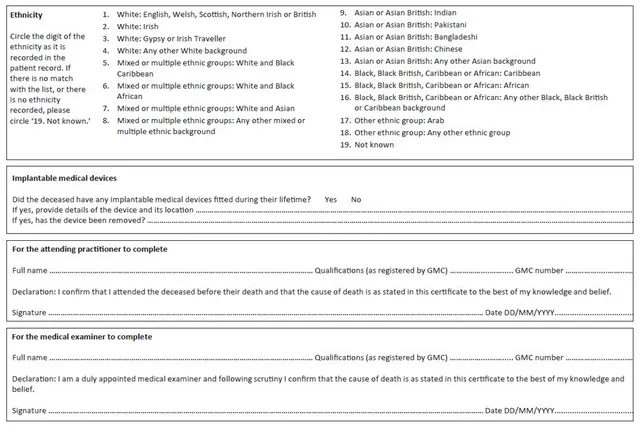
The GP who knew your loved one completes the medical certificate of cause of death in the days that follow, and in England and Wales a medical examiner reviews it and rings you before it goes to the registrar. The medical certificate of cause of death, explained covers that, and how to register a death covers the appointment that follows.
If the death was not expected
Someone who was not under a doctor’s care for a terminal illness, or who died suddenly, in an accident, or in a way no one anticipated.
Step 1: ring 999
Ask for an ambulance if there is any chance the person can be helped, and the police otherwise; the operator will send both if needed. The ambulance crew will confirm the death if it is certain. The police attend every unexpected death at home, because that is the procedure for any death a doctor cannot account for, and their presence is not an accusation.
Step 2: the coroner
The police report the death to the coroner, and the coroner’s own contractor, not your funeral director, takes your loved one to the mortuary for a post-mortem. This is the part families find hardest, and it is routine. What happens when the coroner is involved explains what follows: usually a post-mortem within days, a cause of death found, and your loved one released to the funeral director of your choice within a week or two.
Step 3: the funeral director, after the release
Once the coroner releases your loved one, the funeral director collects them from the coroner’s mortuary, and everything from there is as it would have been. Tell us it was a coroner’s case on the first call and we deal with the coroner’s office directly.
Medication and equipment
After an expected death, the medicines in the house should be returned to a pharmacy, which will take them without question; the district nurses will usually arrange for any equipment, a bed or a hoist, to be collected. Nothing needs to happen with either on the day.
Everything after
Registering the death, Tell Us Once, the funeral and the rest are the same whether the death was at home or in hospital, and what to do when someone dies puts them in order. If a direct cremation is the funeral, direct cremation step by step picks up from the collection.
We collect from homes in London, Nottinghamshire and Doncaster at any hour, and a standard home collection is included in our £1,295 direct cremation.
Direct cremation, £1,295 fixed- Citizens Advice, What to do after a death
- GOV.UK, What to do when someone dies, step by step
- GOV.UK, An overview of the death certification reforms
- Ministry of Justice, Guide to coroner services for bereaved people
- GOV.UK, What to do after someone dies, when a death is reported to a coroner

Need to talk to someone?
We answer at any hour, and a call costs nothing. Tell us where your loved one is and we will tell you what happens next.
020 4559 2705