
The medical certificate of cause of death, explained
The MCCD is the doctor's certificate of why someone died, and without it nothing else can happen. Here is who issues it, what the medical examiner does with it, what it says, and how it differs from the death certificate you will hold.

Need to talk to someone?
We answer at any hour, and a call costs nothing. Tell us where your loved one is and we will tell you what happens next.
020 4559 2705At a glance
- What it is
- The certificate a doctor completes stating the cause of death, and the medical examiner's review of it, before a death can be registered.
- Who handles it
- A doctor who attended the person completes it. A medical examiner reviews it and rings the family. The registrar receives it and registers the death.
- How long it takes
- Usually two or three working days from the death to the registrar having it, in England and Wales. Longer if the coroner is involved.
Two certificates follow a death in the UK, and families confuse them because both have “certificate” and “death” in the name. The medical certificate of cause of death, which the funeral trade calls the MCCD, is the doctor’s statement of why the person died, and it goes to the registrar. The death certificate is what the registrar then issues to you, and it is the document banks and insurers will ask for. This guide is the first of the two, from the doctor to the registrar, and how it has changed since 2024.
Who issues the MCCD
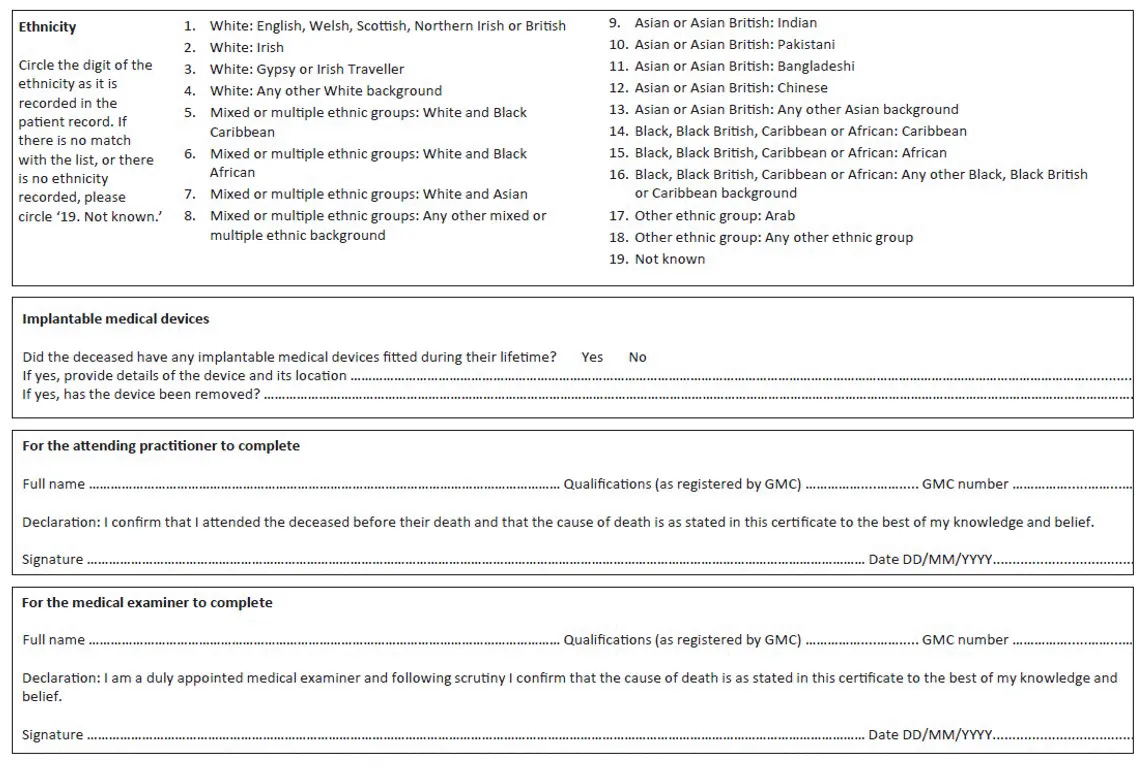
A doctor who attended your loved one, in their final illness or at some point in their lifetime. In a hospital that is the doctor on the ward, and the hospital’s bereavement office coordinates it. At home it is the GP, or a doctor from the practice. Since September 2024 in England and Wales the old rule that the doctor had to have seen the person within the last 28 days has gone, so a GP who knew them can certify a death they did not attend at the end.
The doctor writes the cause of death in the form medicine uses: the immediate cause, the conditions that led to it, and any other conditions that contributed. That is what is on the certificate, and it is what will appear on the death certificate later.
What the medical examiner does
In England and Wales every death not referred to the coroner is now reviewed by a medical examiner, an independent senior doctor, before it can be registered. The examiner looks at the medical records and the proposed cause of death, and the examiner’s office rings the family. That call is to tell you the cause of death in plain words, to ask whether you have any concerns about the care or the death, and to check the details. It is not an investigation and it does not mean anything is wrong; it happens for everyone. If you do have a concern, this is the moment to say so, and the examiner can refer the death to the coroner.
Once the examiner is satisfied, the MCCD goes electronically to the register office, and you are told that you can book the registration. In Scotland and Northern Ireland there is no medical examiner step, and the doctor or the hospital sends the certificate to the registrar; in Scotland you need to know which office it went to.
What happens when a doctor cannot issue one
If no doctor can give a cause of death, or the death was sudden, unexplained, violent, in custody, or during or soon after an operation, the death is referred to the coroner and there is no MCCD. The coroner’s office arranges a post-mortem or opens an investigation, and the registration waits for the coroner’s own certificate. What happens when the coroner is involved explains the stages and how long each tends to take.
What is written on it
The person’s details, the place and date of death, and the cause in the medical form above. Some causes are not accepted on their own: “old age” is accepted only for a person over 80 whose decline the doctor observed, and “natural causes” is not accepted without a condition named. If the doctor is unsure, the examiner or the coroner resolves it. Families sometimes disagree with the wording; the medical examiner’s call is where to raise it, and the wording can be changed before it reaches the registrar but rarely after.
The death certificate is a different document
Once the death is registered, the registrar issues the death certificate: a certified copy of the entry in the register, with the cause of death from the MCCD on it. That is the document you will hold, and the one every bank, insurer and pension provider will ask to see. Buy several certified copies at the registration; how to get a death certificate covers how many and what to do if you need more later, and how to register a death covers the appointment itself.
What you have to do
Wait for the medical examiner’s call, answer it, and then book the register office. Nothing else. What to do when someone dies puts this step among the others, and if a cremation is the next thing, it cannot be booked until the registrar has the certificate, which is why we start the rest of the cremation paperwork while the examiner is reviewing.
If the cremation is the next thing to arrange, our direct cremation is £1,295, fixed, and the cremation cannot be booked until this certificate has gone through, so we start the rest of the paperwork while you wait for it.
Direct cremation, £1,295 fixed- GOV.UK, An overview of the death certification reforms
- GOV.UK, Register a death
- Department of Health and Social Care, Medical certificate of cause of death (MCCD): guidance for medical practitioners
- mygov.scot, Register a death
- NI Direct, Registering a death with the district registrar
- Citizens Advice, What to do after a death

Need to talk to someone?
We answer at any hour, and a call costs nothing. Tell us where your loved one is and we will tell you what happens next.
020 4559 2705