How to register a death: what to bring and the five-day rule
A death in England, Wales or Northern Ireland is registered within five days, in Scotland within eight, by appointment at a register office. Here is who can do it, what to bring, what you leave with, and what pauses the clock.

Need to talk to someone?
We answer at any hour, and a call costs nothing. Tell us where your loved one is and we will tell you what happens next.
020 4559 2705At a glance
- What it is
- The appointment at the register office at which a death is legally recorded.
- Who does it
- A relative, someone present at the death, or the person arranging the funeral. About half an hour with the registrar.
- How long it takes
- Within five days in England, Wales and Northern Ireland, eight in Scotland. In England and Wales the days run from the registrar receiving the certificate; elsewhere from the death, paused if the coroner is involved.
Registering the death is the step with the hardest deadline and the least explanation. It is an appointment at a register office, about half an hour with a registrar, at the end of which the death is on the public record and you hold the documents everything else depends on. This guide is the appointment, from who is allowed to book it to what you carry out.
Step 1: know your deadline
In England, Wales and Northern Ireland, five days. In Scotland, eight. In Scotland and Northern Ireland the days count from the death itself, and a referral to the procurator fiscal or the coroner stops the clock until they have finished. In England and Wales, since September 2024, the five days run from the day the registrar receives the certificate from the medical examiner or the coroner, so the clock does not start until the review is done.
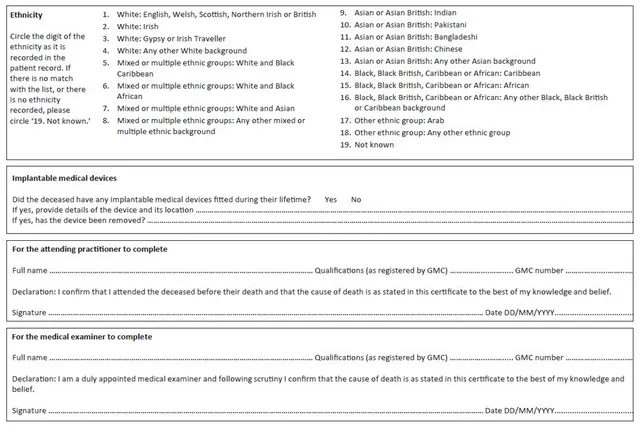
In England and Wales there is a step before the appointment: the medical certificate of cause of death goes from the doctor to a medical examiner, who reviews it and rings you, and only then to the registrar. You cannot book until the registrar has it. The medical certificate of cause of death, explained covers that stage. Scotland and Northern Ireland have no examiner stage, so the registrar has the certificate as soon as the doctor or the hospital has sent it; in Scotland, ask which office that was.
Step 2: check you are allowed to register
The law lists who may. A relative of the person who died; someone who was present at the death; the occupier of the building where the death happened, which is how a care home manager can do it; or the person arranging the funeral, which can be the executor. One of the family usually does it, and it does not have to be the next of kin. If no relative is able to, the funeral director or a friend who is arranging the funeral can.
Step 3: book the appointment
Any register office in England and Wales can register a death that happened anywhere in England and Wales, though the office for the district where the death happened is quickest, because another office has to send the details across. In Scotland any registration office; in Northern Ireland any district registrar. Book online or by phone the day you are told the certificate is through. Some registrars will register by phone or video; ask.
Step 4: bring what you have
The registrar can proceed without some of this, but each gap is a question answered from memory. Bring:
- In Scotland, the name of the registration office the doctor sent the certificate to; elsewhere the registrar already has it
- Your own identification
- The person’s full name and any previous names, including a maiden name
- Their date and place of birth, and their birth certificate if you have it
- Their last address and their occupation
- The full name and occupation of their spouse or civil partner, living or not
- Their NHS number, if you have it, and their National Insurance number
- Whether they received a state pension or any benefit
- Money for the certified copies
Step 5: what you leave with
Three things.
The death certificate: a certified copy of the entry in the register, which is what banks, insurers and pension providers will ask to see. Buy several; how to get a death certificate covers how many and how to get more later.
The certificate for burial or cremation, the green form, which the crematorium or the cemetery needs before the funeral can be booked. Give it to the funeral director. If the coroner is involved, the coroner issues the equivalent instead.
A reference number for Tell Us Once, the service that tells the government departments in one report. It lasts 28 days. How Tell Us Once works explains what it covers.
What if the deadline passes
Ring the register office and explain. The registrar will still register the death; the duty is to register it, and a family a few days late because no slot was available is not at fault.
If the death was abroad, or the funeral is
A death abroad is registered in the country where it happened, not here; bringing someone home to the UK explains what the UK requires instead. A death here where the funeral is abroad is registered here in the ordinary way, and the death certificate is the first of the documents the repatriation needs; sending someone home from the UK takes it from there. What to do when someone dies puts the registration among the other steps.
If the cremation is the next thing, ours is £1,295, fixed, and the registrar's certificate for cremation you leave with is the document we need to book it.
Direct cremation, £1,295 fixed- GOV.UK, Register a death
- NI Direct, Registering a death
- mygov.scot, Registering a death
- GOV.UK, An overview of the death certification reforms
- Births and Deaths Registration Act 1953, sections 16 and 17
- National Records of Scotland, Registering a death
- Citizens Advice, What to do after a death

Need to talk to someone?
We answer at any hour, and a call costs nothing. Tell us where your loved one is and we will tell you what happens next.
020 4559 2705