What happens when someone dies in hospital
The ward looks after the first hours, the bereavement office looks after the paperwork, and your loved one is cared for in the hospital mortuary until a funeral director collects them. Here is the sequence, and where you come in.


Need to talk to someone?
We answer at any hour, and a call costs nothing. Tell us where your loved one is and we will tell you what happens next.
020 4559 2705At a glance
- What it is
- The sequence after a death in an NHS hospital, from the ward to the funeral director.
- Who does it
- The ward staff, then the hospital's bereavement office, then the medical examiner. The family chooses the funeral director.
- How long it takes
- The bereavement office usually contacts you within a working day or two. Your loved one can be collected once the medical certificate has been done, typically within a few days.
More than four in ten deaths in the UK happen in hospital, and a hospital has a settled sequence for what follows. It runs from the ward, to the bereavement office, to the medical examiner, to the mortuary, and finally to the funeral director the family chooses. The family’s part is smaller than it feels at two in the morning, and this guide is the sequence in order, with where you come in.
Step 1: on the ward, the first hours
A doctor or a senior nurse confirms the death, and the staff will tell you. You can stay with your loved one, and most wards will let the family sit for as long as they need, wash or dress them if the family’s tradition asks for it, and call the hospital chaplain or a leader of any faith. Say what you want; staff will not always offer, but they will nearly always agree.
When you are ready, the staff prepare your loved one and take them to the hospital mortuary, where they are cared for until a funeral director collects them. Nothing else happens that night.
Step 2: the bereavement office
Every hospital has one, and it works office hours. It will contact you, usually within a working day or two, or you can ring it in the morning. The bereavement office is the family’s single point of contact for everything the hospital does after a death: it coordinates the medical certificate, returns the belongings, tells you when your loved one can be collected, and answers the questions on this page for your particular hospital. If you are not contacted within two working days, ring.
Step 3: the medical certificate
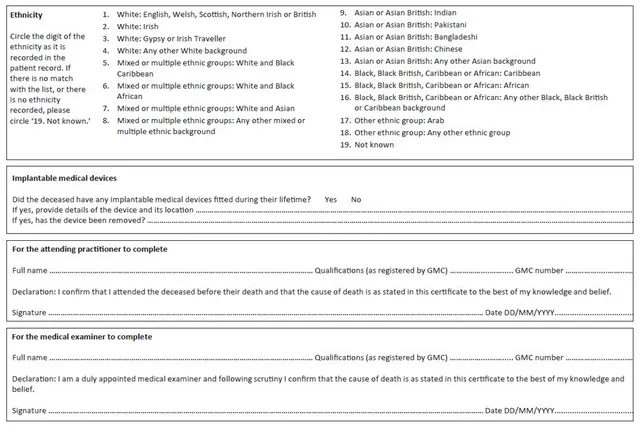
A doctor who treated your loved one completes the medical certificate of cause of death, and in England and Wales a medical examiner reviews it and rings you to talk it through. Once cleared, it goes electronically to the register office and you can book the registration; the medical certificate of cause of death, explained covers this in detail. If the doctors cannot give a cause, or the death was unexpected or during treatment, the death is referred to the coroner, and what happens when the coroner is involved explains that.
Occasionally the hospital asks the family’s consent to a hospital post-mortem, to learn more about the illness. This is different from a coroner’s post-mortem: it is a request, the family can say no, and saying no changes nothing else.
Step 4: the belongings
The ward or the bereavement office holds your loved one’s property, clothes, glasses, a phone, a watch, and returns it to the next of kin, usually against a signature. Valuables may be held by the hospital’s cashier. Ask the bereavement office where each is; families are sometimes sent between three places for one bag.
Step 5: choosing a funeral director
The hospital will not recommend one and does not need you to have chosen on the first day. When you have, tell the bereavement office the name, and the funeral director deals with the hospital directly from then on: the release paperwork, the collection time, the mortuary. What to do when someone dies puts the choice of funeral among the other decisions, and direct cremation step by step is what follows if that is the choice.
Step 6: the collection
Once the medical certificate has gone through, the bereavement office releases your loved one to the funeral director, who collects from the hospital mortuary with the paperwork the hospital gives them. Typically that is within a few days of the death. Your loved one then goes to the funeral director’s chapel of rest, and the funeral director tells you they have arrived. If you want to see your loved one before then, most hospitals have a viewing room at the mortuary and the bereavement office arranges it.
If your loved one was from abroad, or is going home abroad
The hospital’s sequence is the same. What changes is what comes after the collection: the coroner has to be notified before anyone leaves the country, and the destination’s consulate has its own requirements. Sending someone home from the UK takes over from step 6, and we deal with the bereavement office in exactly the same way.
Registering the death
The registration is yours to do, by appointment, within five days in England, Wales and Northern Ireland, counted in England and Wales from the day the registrar receives the certificate; how to register a death is the guide for the appointment. It is the only step in this sequence that the hospital does not do for you.
We collect from any hospital in England, and our direct cremation is £1,295, fixed. Tell the bereavement office our name and we deal with them directly.
Direct cremation, £1,295 fixed- Citizens Advice, What to do after a death
- GOV.UK, An overview of the death certification reforms
- GOV.UK, Register a death
- Human Tissue Authority, Post mortem examinations
- GOV.UK, What to do after someone dies, arrange the funeral

Need to talk to someone?
We answer at any hour, and a call costs nothing. Tell us where your loved one is and we will tell you what happens next.
020 4559 2705